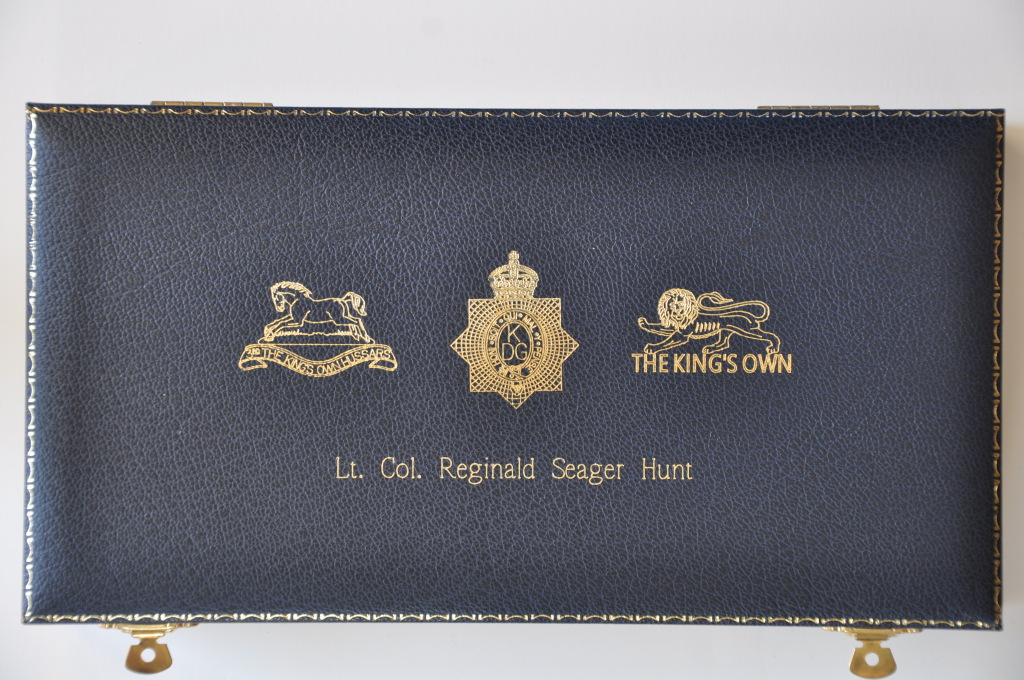
The embossed imprints are the cap badges of the three regiments with which Reggie served when he was awarded the enclosed medals
1) Hussars Regiment
2) 1st King’s Dragoon Guards
3) King’s Own (Royal Lancaster) Regiment
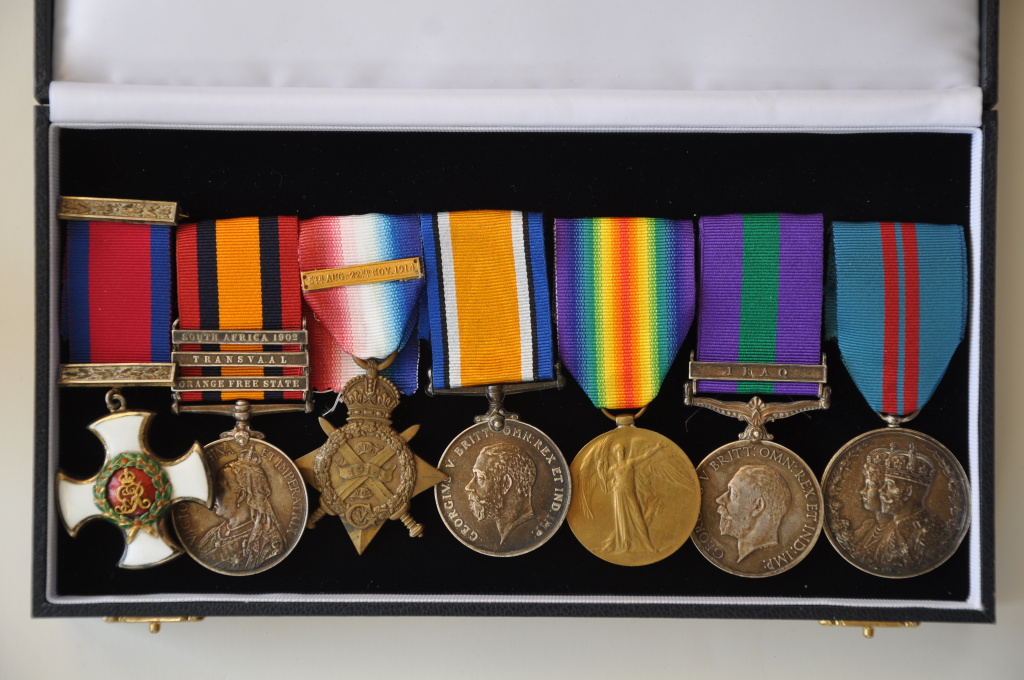
The D.S.O. group of medals of Lt.Col. R.S. Hunt were put up for sale by Spink’s auction house in their “Orders, Decorations and Medals” sale of 24th April 2025. I spotted the sale some 3 to 4 weeks later and mailed Spink’s auction manager hoping against hope that it might be possible to contact the buyer. To my great surprise they forwarded my email to the buyer who then mailed me back to say that he was a private collector in Canada and, due to my interest and relationship to the recipient of the medals, he would be prepared to sell them to me at cost. After some negotiations, the medals were posted on 23rd June. The item on Spink’s website shows a certain amount of detail about the medals (not all of it correct) but I can add much more detail.
Military Career
- February 1883 to May 1897, 3rd Battalion Norfolk Regiment as 2nd Lt. and Lt.
- May 1897 to June 1911, 3rd King’s Own Hussars as 2nd Lt., Lt., Capt. and Major
- June 1911 to September 1921, 1st King’s Dragoon Guards as Major
- June 1916 to October 1916, attached to 1/4th Seaforth Highlanders as 2nd in command
- October 1916 to March 1918, attached to 8th King’s Own (Royal Lancaster) Regiment as temporary Lt. Col. in command
- March 1918, reverted to rank of Major in the 1st King’s Dragoon Guards
- At retirement in September 1921, granted rank of Lt.Col. in the 1st King’s Dragoon Guards
Distinguished Service Order
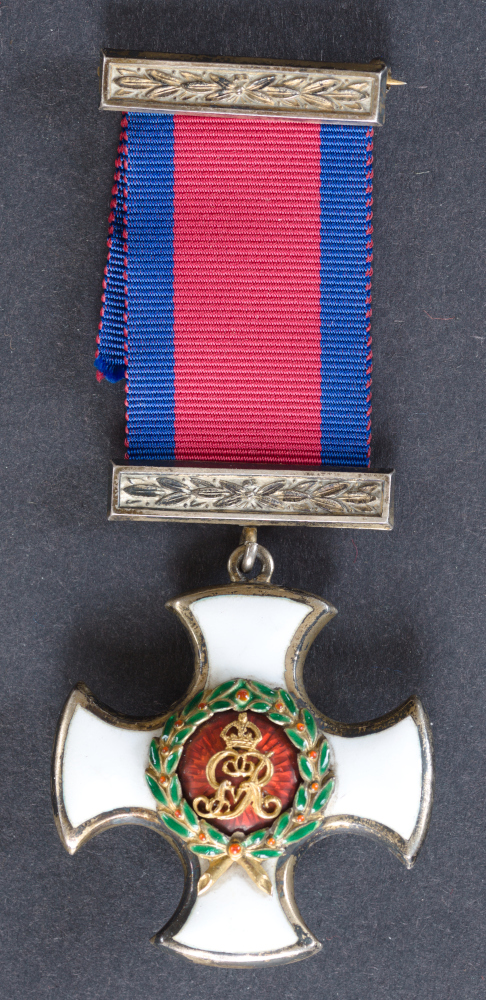
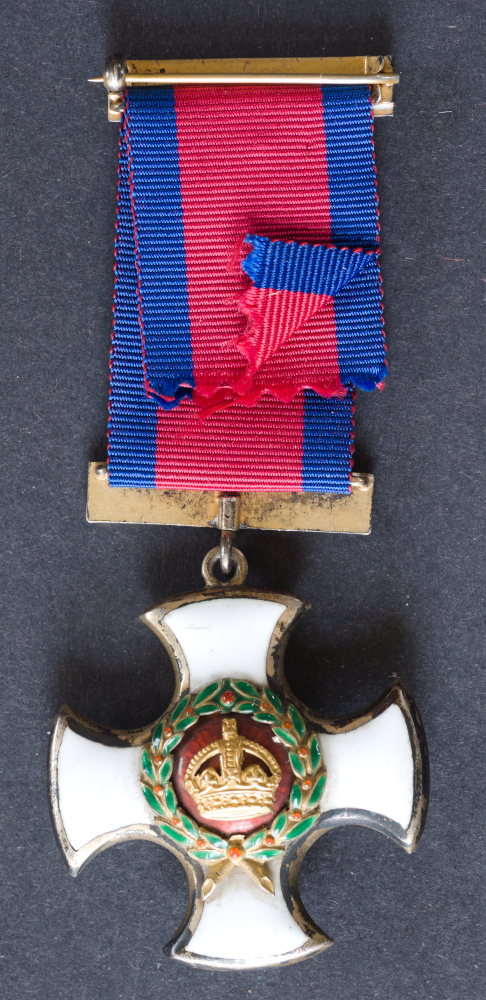
According to the MOD website, “the Distinguished Service Order is an operational gallantry award given for highly successful command and leadership during active operations.”
In his memoirs, written in December 1936, Reggie says
I got the D.S.O. for a little place called Monchy Le Preuse just outside Arras. I was told to take it. My Battalion did. We took it & held it for 3 days. I took 884 lads & 27 officers into action, & on relief had 23 men left, & 3 officers besides myself, all of us bleedy-bloody.
Also, in a letter to his sister and our grandmother, Helen, on the night of the 5th/6th May 1917 from trenches to the east of Arras while C.O. of the 8th King’s Own (Royal Lancaster) Regiment, he says
The General has again put me in for a D.S.O. & I’m big enough not to be even grateful. It is a note of sour grape business. There are few soldiers out here even Generals who have served out here as long as I have. I’ve worked hard & with all my might at every job, I’ve had a bad time with trench-foot, pneumonia etc, Neuritis has done my old bones in & I’ve been wounded twice. I’ve fought at Festubert, Ypres, the Somme, the Ancre & now here. I’ve damn-all to show for it but thousands of fellows get medals decorations & mentions for an eighth of what I’ve been through. I don’t want a D.S.O. I do long for a Legion of Honour.
In contrast to Reggie’s own recollections, the war diaries for the 8th King’s Own (Royal Lancaster) regiment show the following actions around Monchy Le Preux and Guémappe during the Battle of Arras in April, May and June 1917.
Zero hour for the Battle of Arras was at 5:30am on the 9th April, 1917. Later that day, the 8th King’s Own moved up to The Harp, an area south-east of Tilloy that earlier in the day had been a German stronghold. In the evening, they were ordered to attack the Brown Lineto the west of Guémappe. Unfortunately, they were unable to fulfil the order due to being about 1¼ miles from the attack point with only 25mins to cover the distance. Nevertheless, with Reggie leading the way, they made their way forward in artillery formation through enemy shrapnel fire. On arrival at the line, they were deployed and dug in for the night. On the 10th, they withdrew to Namur Trench. On the 11th, the battalion was ordered to attack and capture Guémappe. The attack went well to start with but met serious machine gun fire after after passing the crest of a hill heading towards Guémappe, causing heavy losses. Reggie was wounded but remained at duty. The attack came to a halt and the exhausted troops were relieved by the 9th Brigade and withdrew to The Harp where they found rations with tea & rum. The battalion had 5 officers killed and 11 wounded. There were also 38 other ranks killed, 164 wounded and 28 missing in action.
After the attack on Guémappe, the battalion spent time recovering in billets in Arras. Between the 14th and 16th April, Reggie attended the local Field Ambulance to have his eyes seen to.
Early in the morning of 24th April, Reggie’s battalion moved back up to the Brown Line and then on to trenches east of Monchy-le-Preux after Monchy had been taken by the 37th Division on the 11th April. Between the 25th April and 1st May they repelled multiple attacks by German forces attempting to recover Monchy, until the battalion was relieved by the 13th King’s Liverpool battalion.
The battalion recovered in the area around Tilloy and Bois des Boeufs until, on the 4th May, they were ordered to move again to the Brown Line west of Monchy. They spent several days digging a communication trench and it was in this period that Reggie wrote the letter to his sister about being put up for the D.S.O. and other things.
On the 10th May, the 8th King’s Own were again posted to trenches east of Monchy. This time the objective was an attack on German forces in Devil’s trench. The attack failed because of heavy machine gun fire and, on the 14th May, they were relieved by the 1st King’s Own Scottish Borderers.
A further period of recovery in Duisans to the west of Arras was followed, on the 14th June, with the battalion being involved in support of a successful attack by the 76th Brigade on Infantry Hill north of Monchy. Subsequently, they moved up to the front line and helped repulse several German counter attacks on Infantry Hill. This was the battalion’s final action in the Battle of Arras and they were relieved by the 36th Brigade on the 20th June.
Later in the year, the battalion was involved in the Battle of Passchendaele with an attack on Zonnebeke as part of the Battle of Polygon Wood on 26th September.
Reggie’s D.S.O. was announced in the New Year’s Honours list for 1918 which meant that there is no citation. We don’t know for certain what the exact reasons were for the award but it is likely that the actions recounted above played a large part.
On 5th Jan 1918 while camping at Hendecourt, the 8th Battalion King’s Own (Royal Lancaster) paraded in recognition of Reggie being awarded the D.S.O.
It is also interesting to note that Reggie’s cousin, Capt. Claude A. Mortimore of 32nd Royal Field Artillery, had been awarded the Legion d’Honneur (Croix de Chevalier) “for [his] gallantry during the Operations between the 21st and 30th August, 1914”
Queen’s South Africa Medal
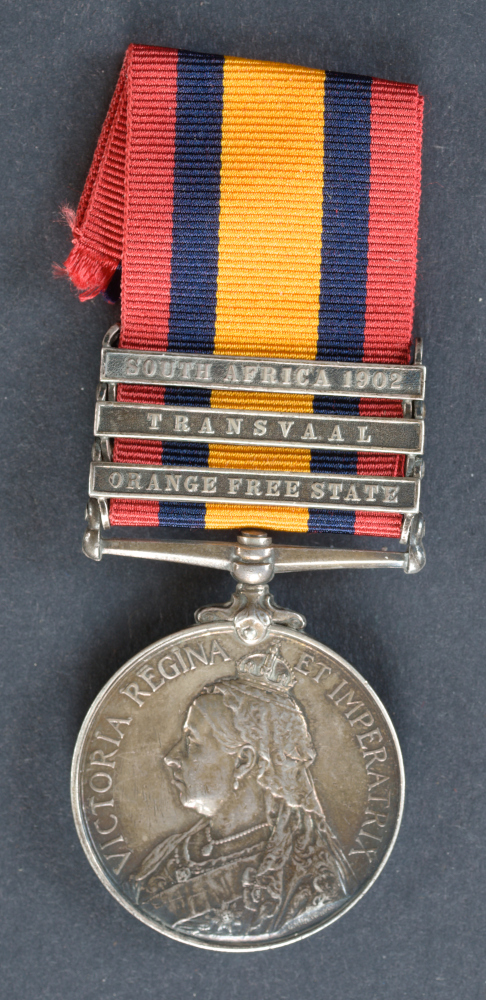
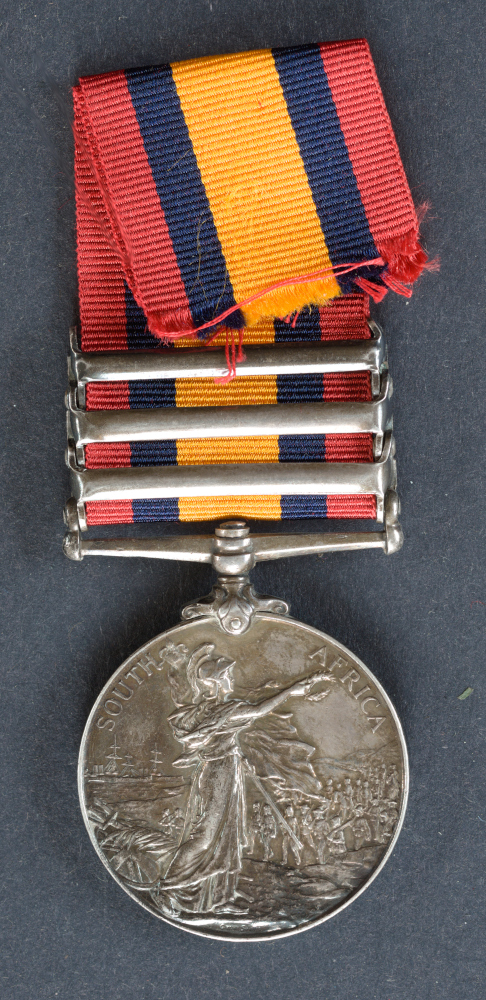
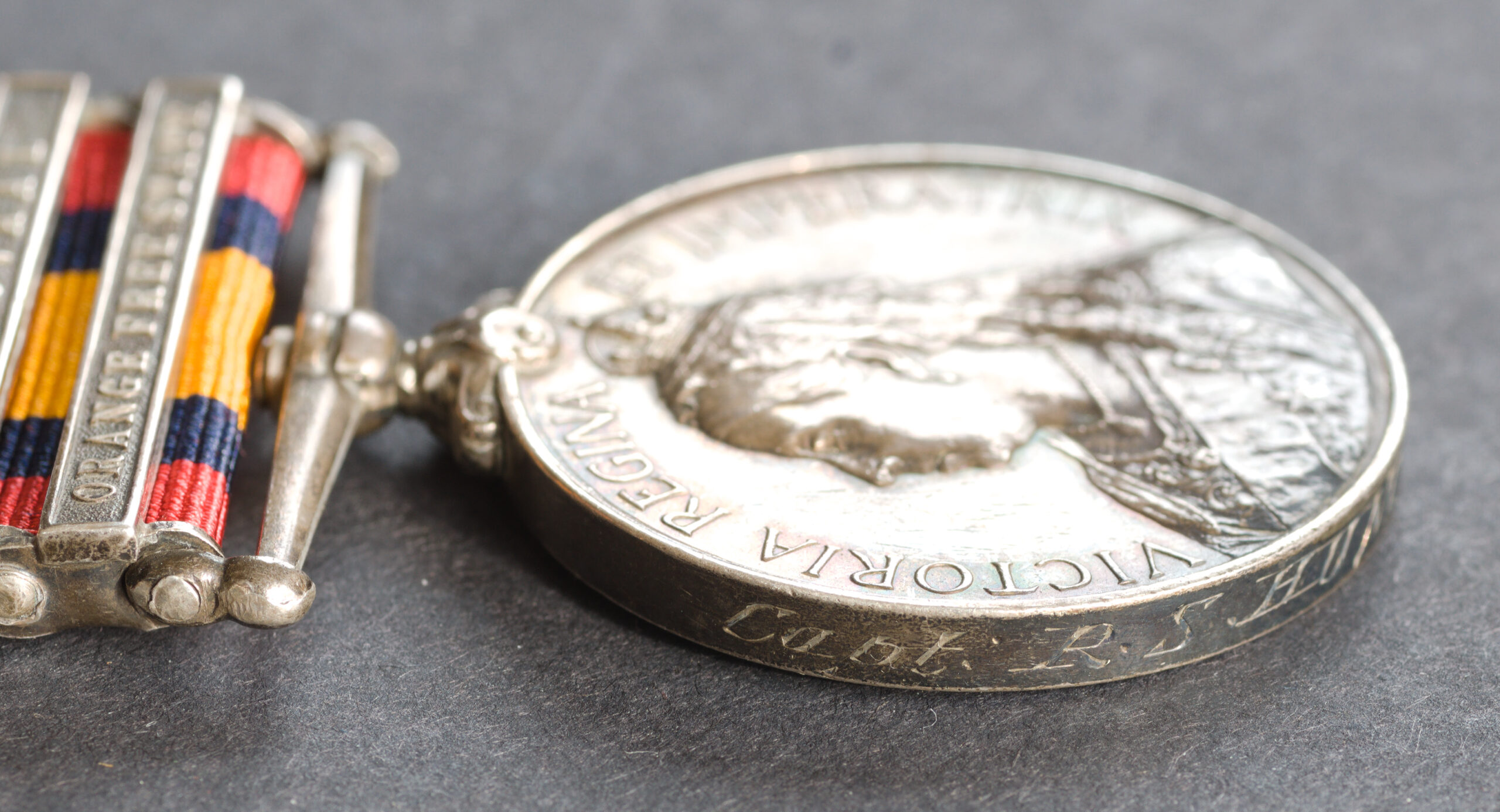
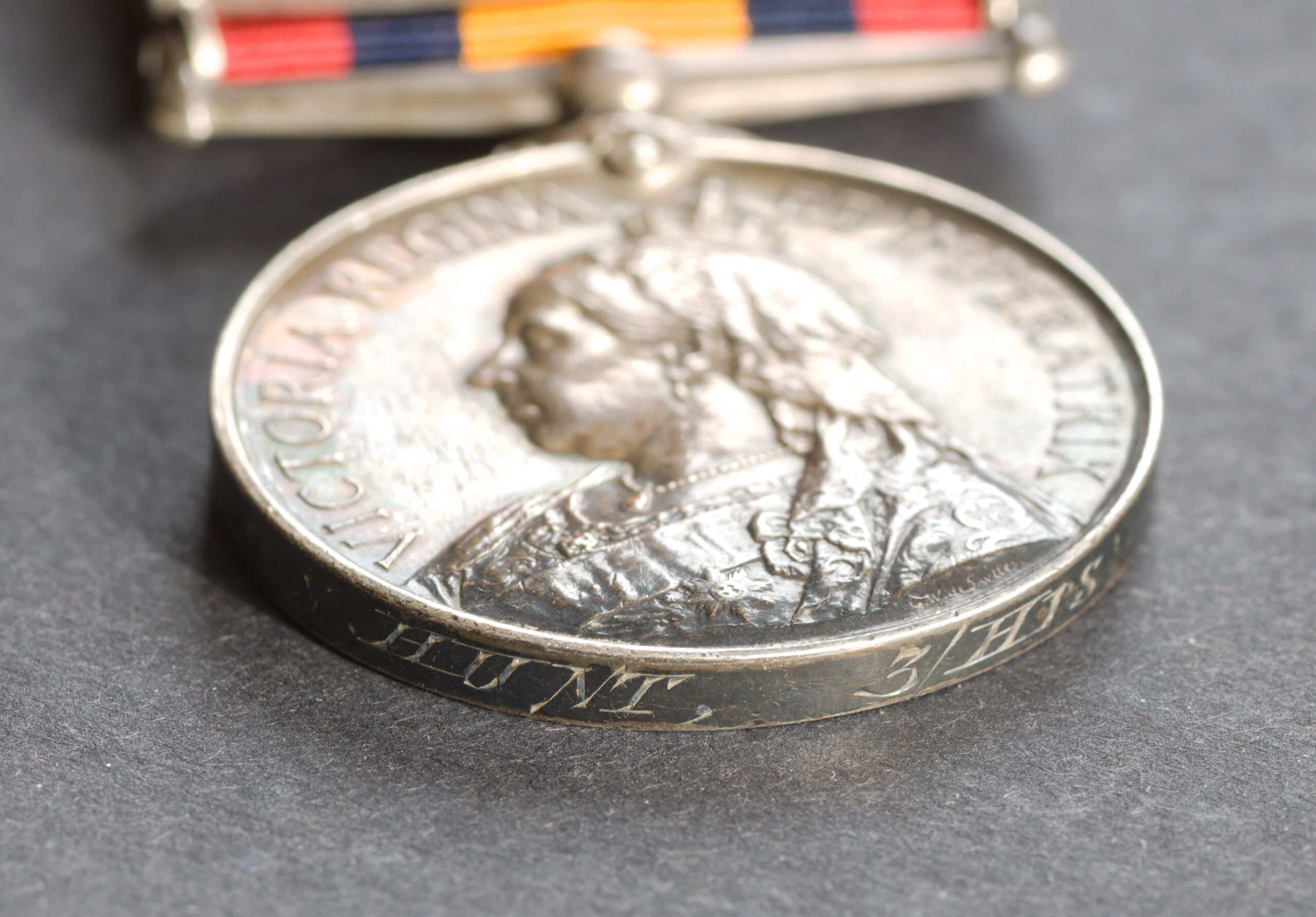
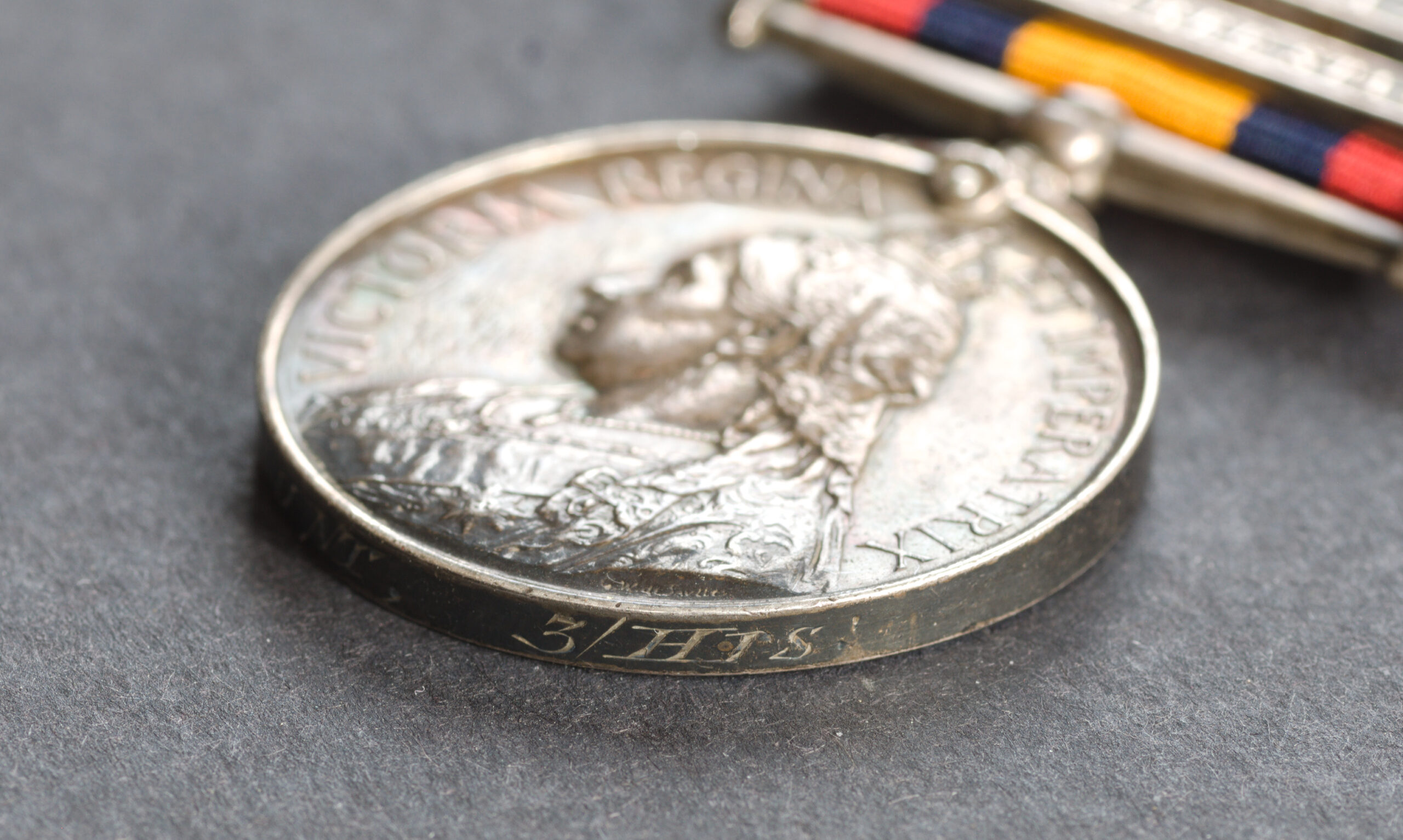
- Orange Free State, 28 February 1900 – 31 May 1902 For service in the Orange Free State where no clasp for a specific action inthe Orange Free State had been received.
- Transvaal, 24 May 1900 – 31 May 1902 For service in the South African Republic where no clasp for a specification in the South African Republic had been received.
- South Africa 1902, 1 January – 31 May 1902 Awarded to those who served in South Africa during 1902 and who were not eligible for the King’s South Africa Medal.
For the 2nd Boer War (1899-1902) in which Reggie served with the 3rd Hussars. There are three clasps :-
The actions of the 3rd Hussars in the Boer War are described in “Our Regiments in South Africa, 1899-1902” page 427 by John Stirling, 1903.
1914 “Mons” Star, British War and Victory Medals
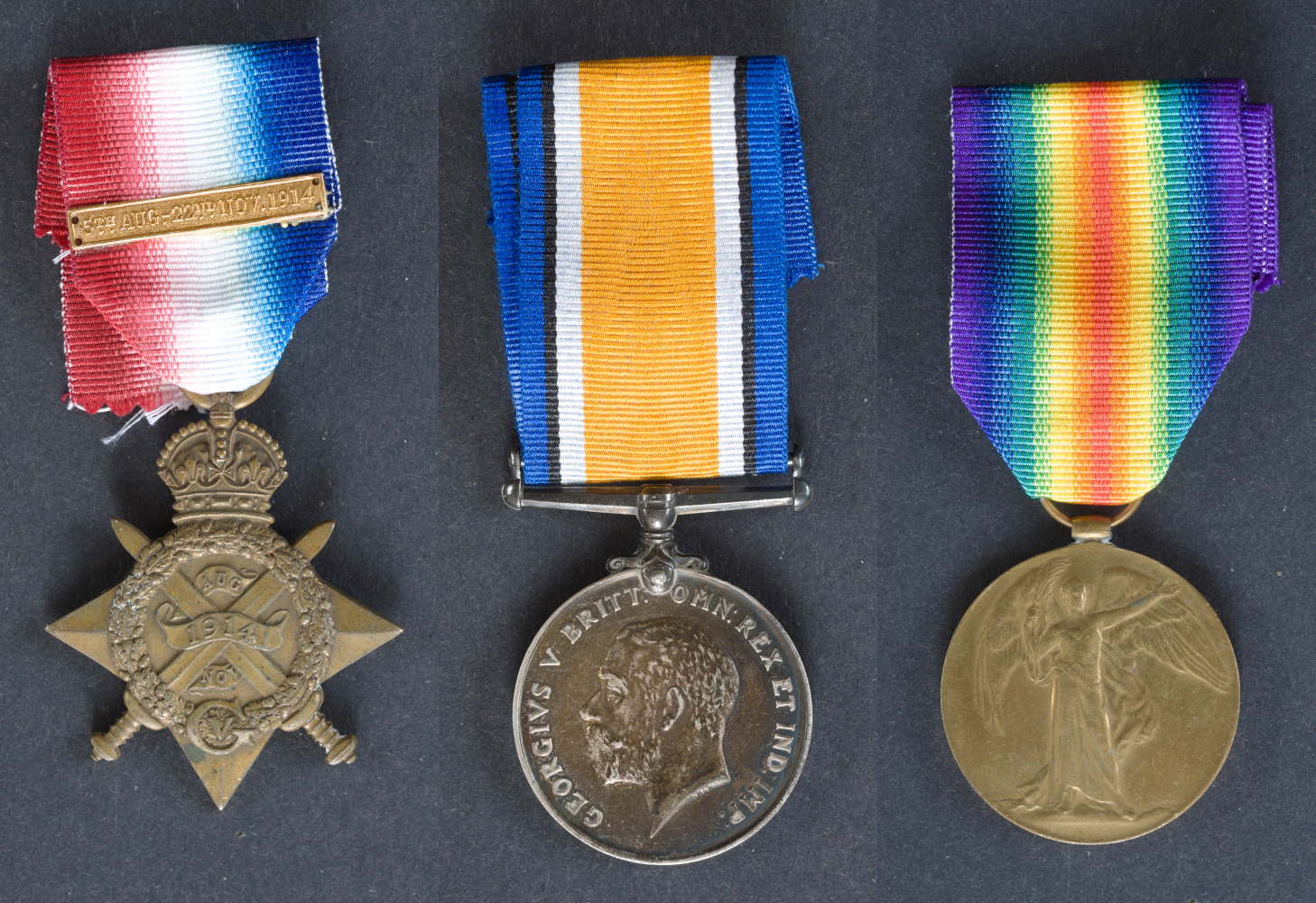
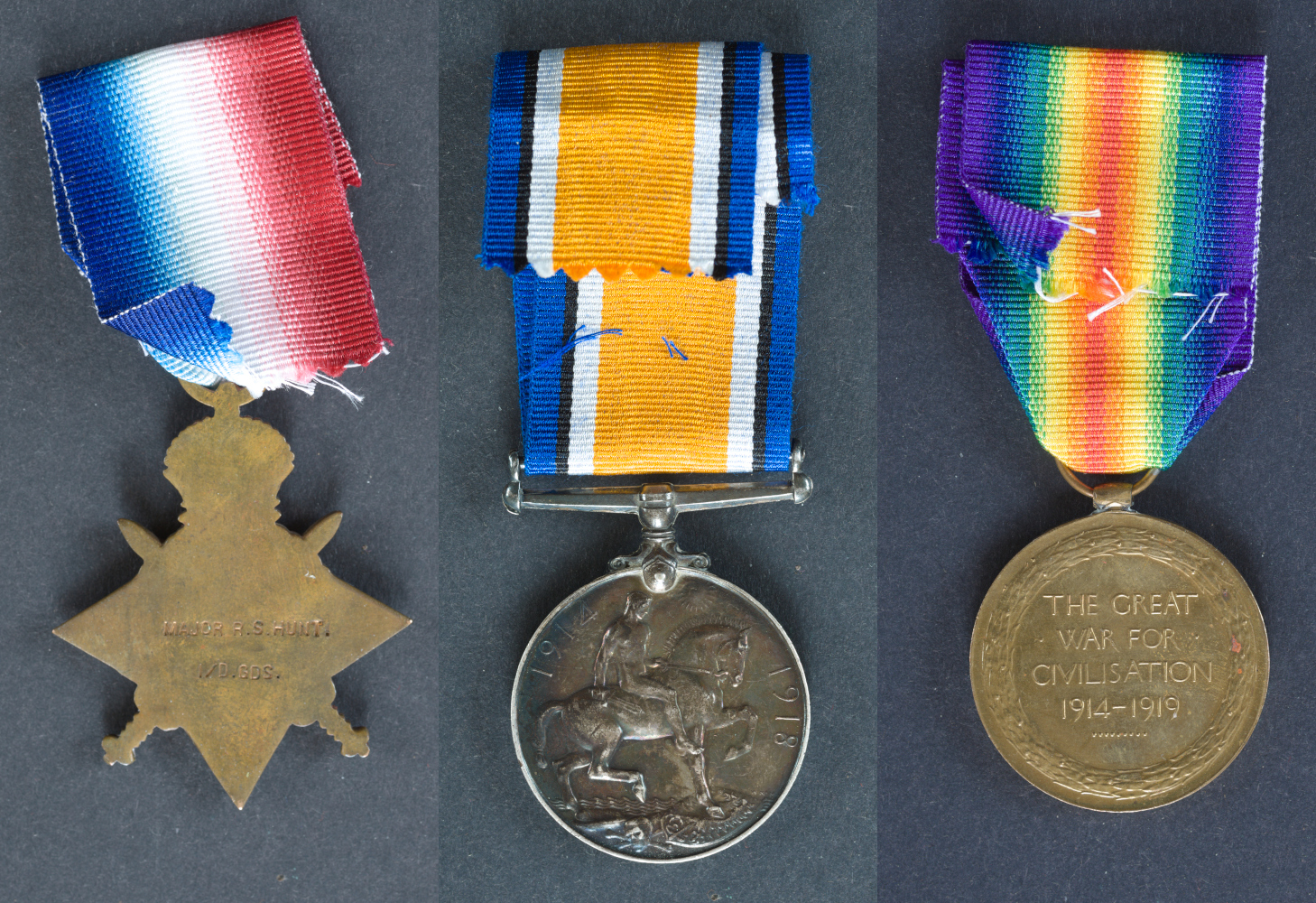
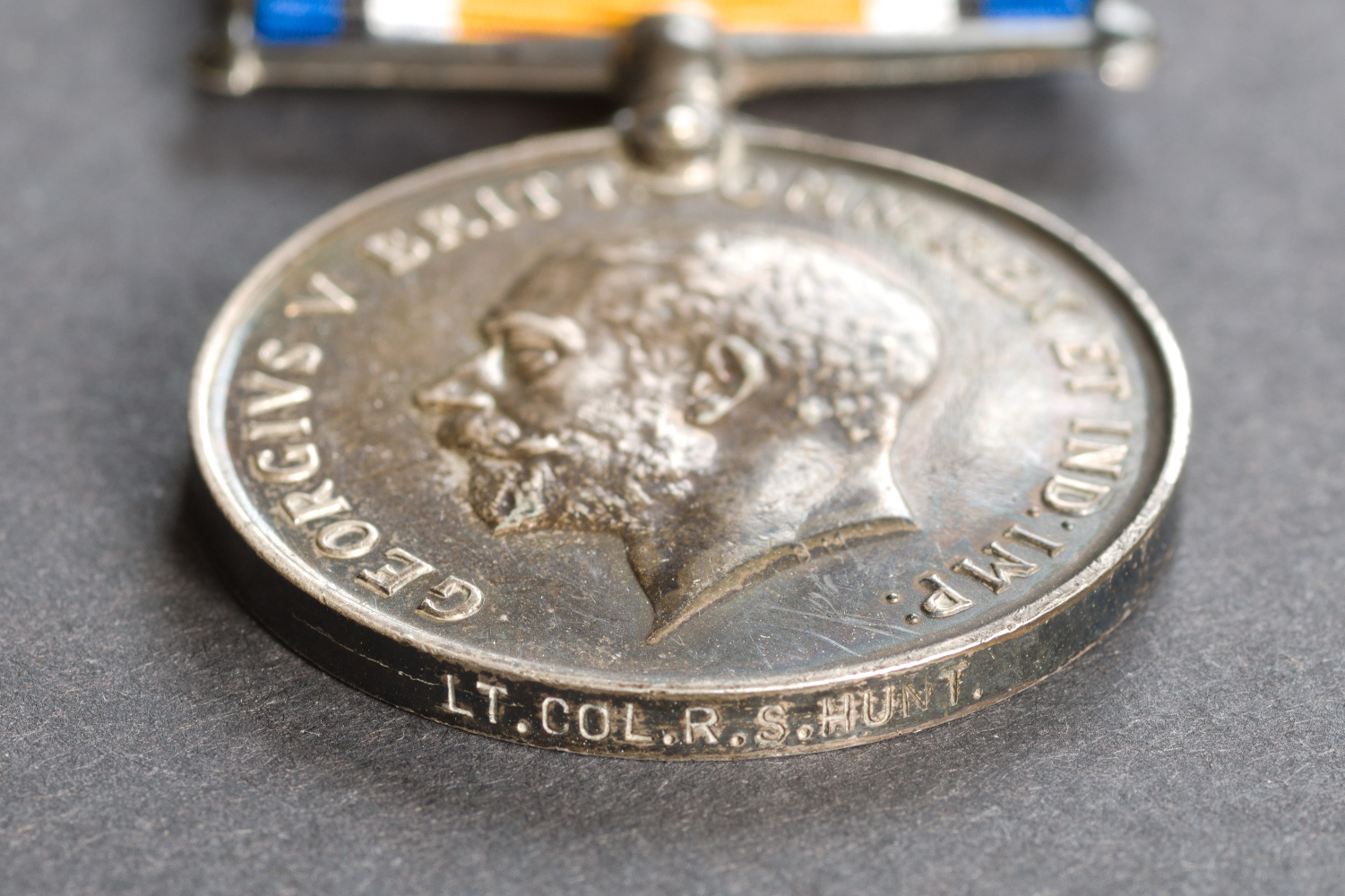
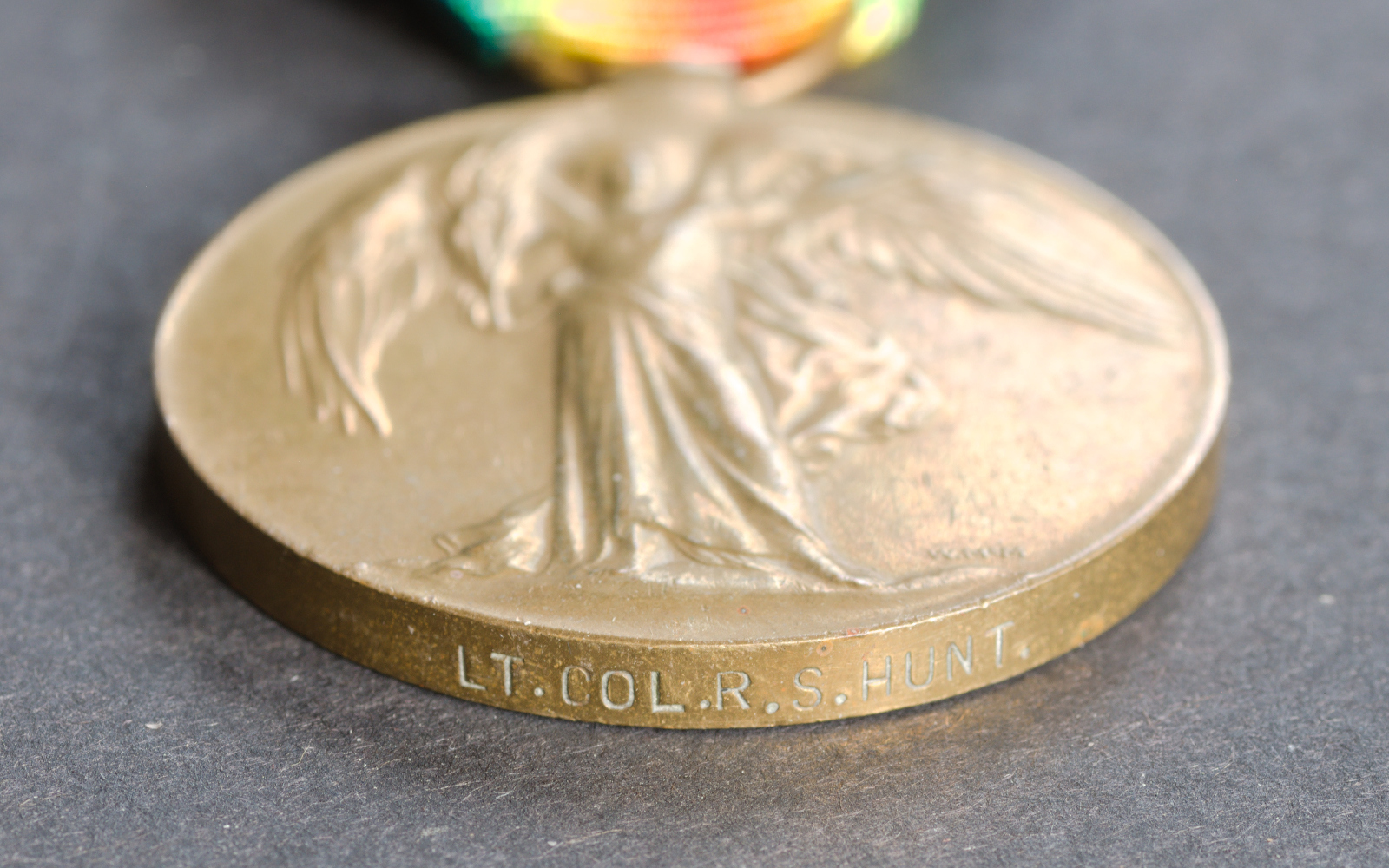
Popularly known at “Pip, Squeak and Wilfred”. These are the campaign medals that all qualifiers received for their involvement in stages of the Great War.
The 1914 “Mons” Star was awarded to everyone who served in France or Belgium between 5th August and 22nd November 1914.
The British War Medal was awarded to officers and men and women of British and Imperial forces for service in the First World War.
The British Victory Medal was issued to all those who received the 1914 Star or the 1914–15 Star and to most of those who were awarded the British War Medal.
General Service Medal with Iraq clasp
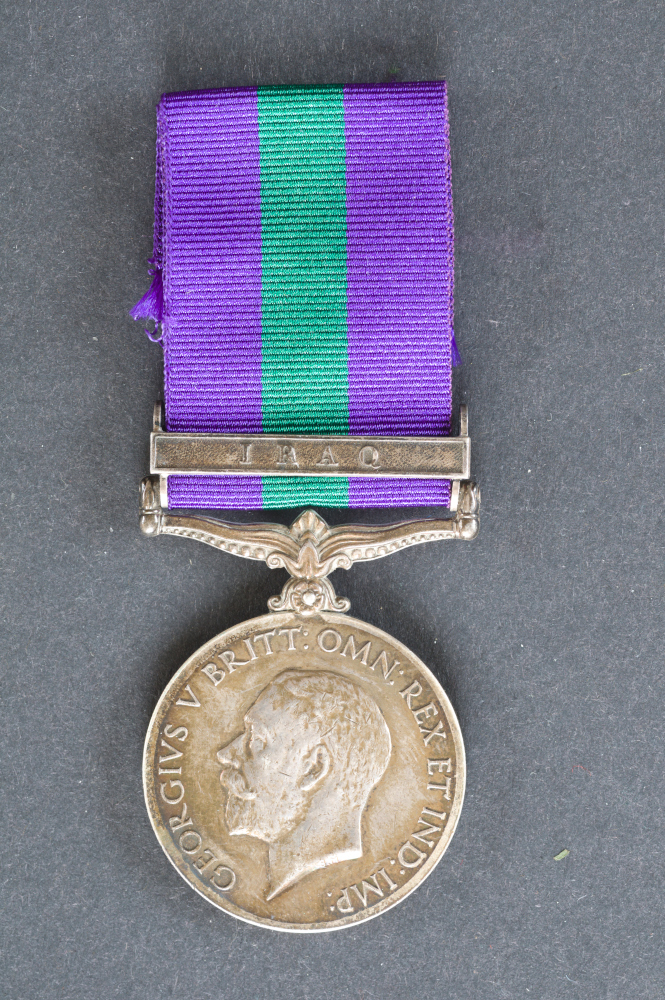
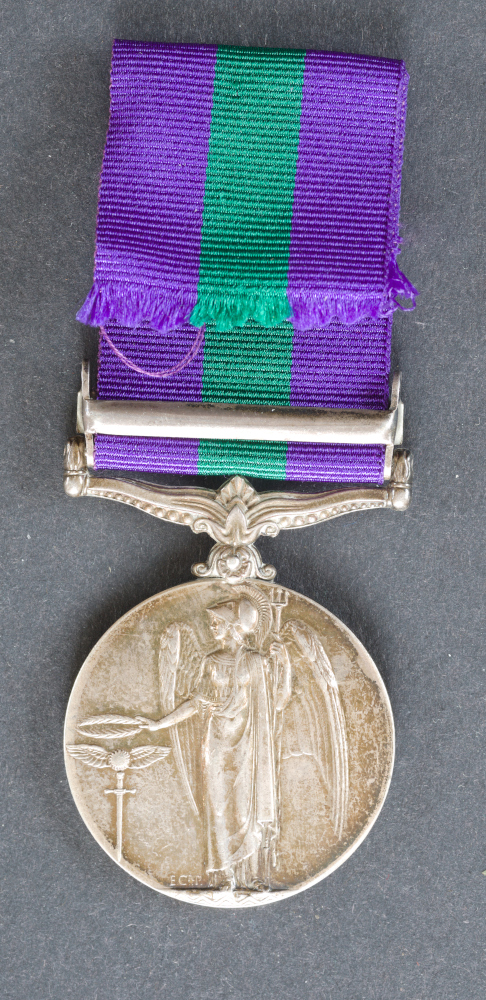
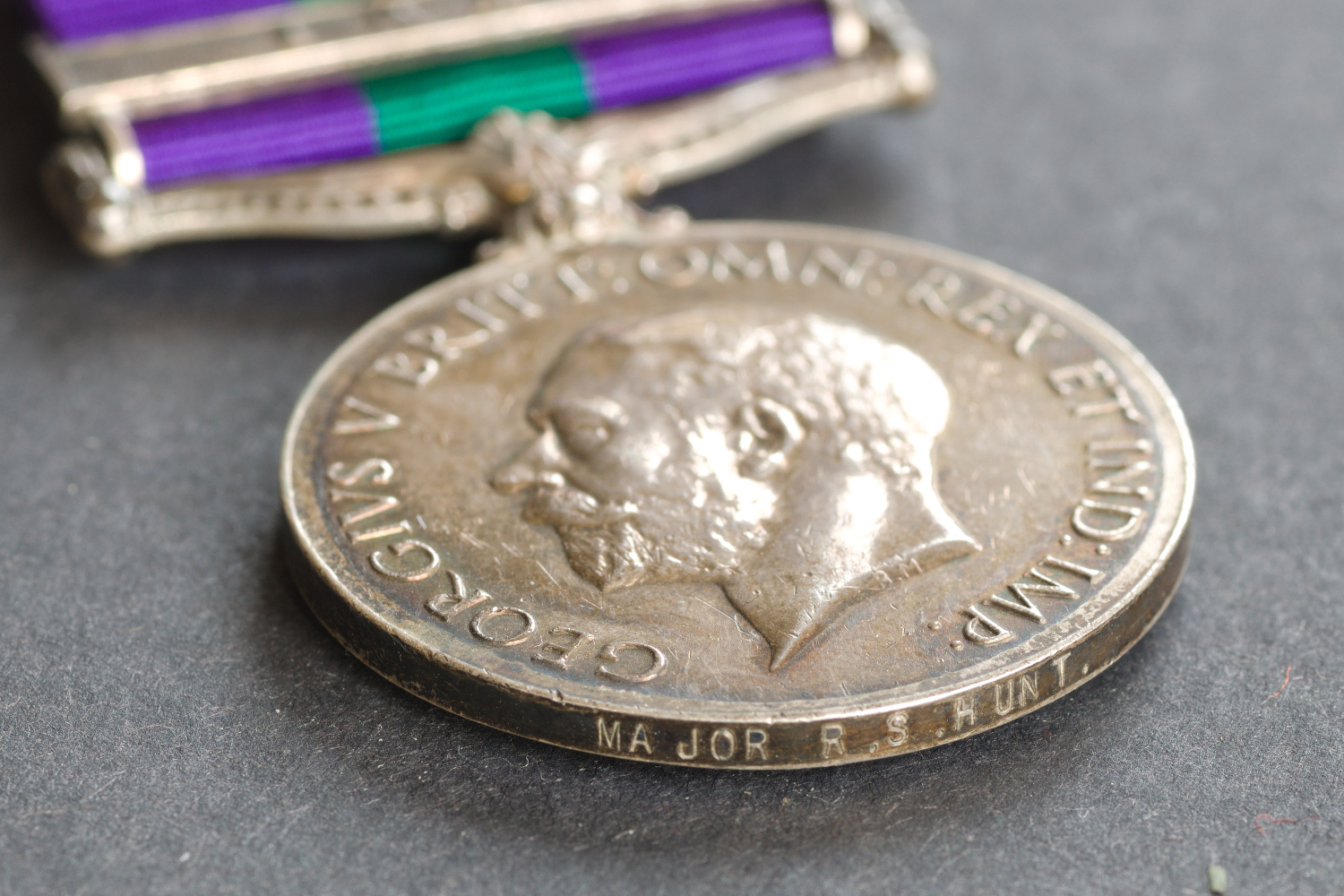
For his operations in Iraq in 1920 with the 1st King’s Dragoon Guards. In his memoirs, Reggie records
Later I rejoined my own Regt. in Baghdad + had a time of it again, under General [Sir Aylmer] Haldane, + fighting had only just ceased when my Regt. was ordered home + we were quartered, 1921, in Edinburgh. So I had 6 whole years, all but periods in hospital, of War.
From an article about R.S.M. F. Burdett of the 1st King’s Dragoon Guards…
The King’s Dragoon Guards departed India, landed in Iraq on January 26th, and arrived at their camp in Baghdad on February 4, 1920. The regiment departed for their summer camp on April 21st, but were ordered back to Baghdad on July 12th to quell a rebellion.[Presumably, the Iraqi Revolt between May and October, 1920]. The regiment conducted numerous patrols from July to October, although they only saw minor action. They were ordered home on November 5th, and arrived in Southampton on December 28, 1920 with a strength of 16 officers and 146 other ranks. For this service, Burdett received the General Service Medal with Iraq clasp.
It seems likely that the gist of this account also applied to Reggie.
Delhi Durbar (1911) medal
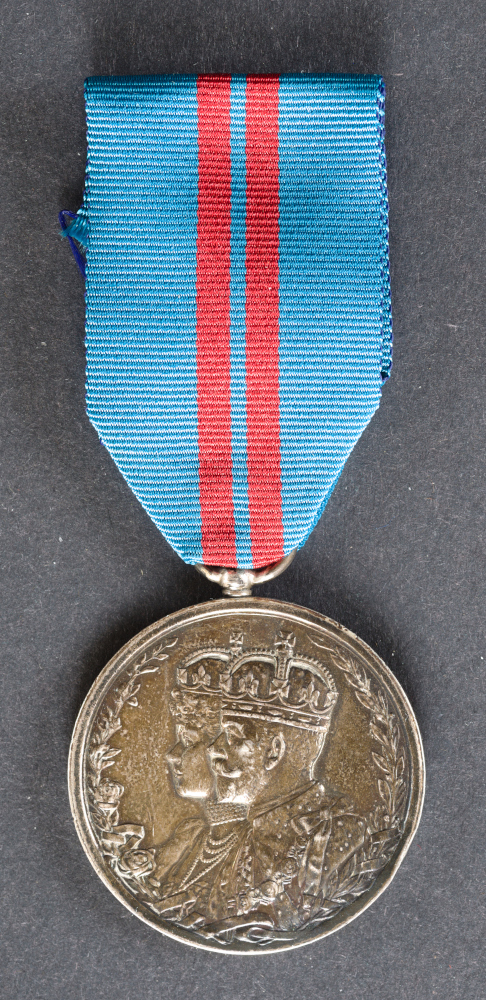
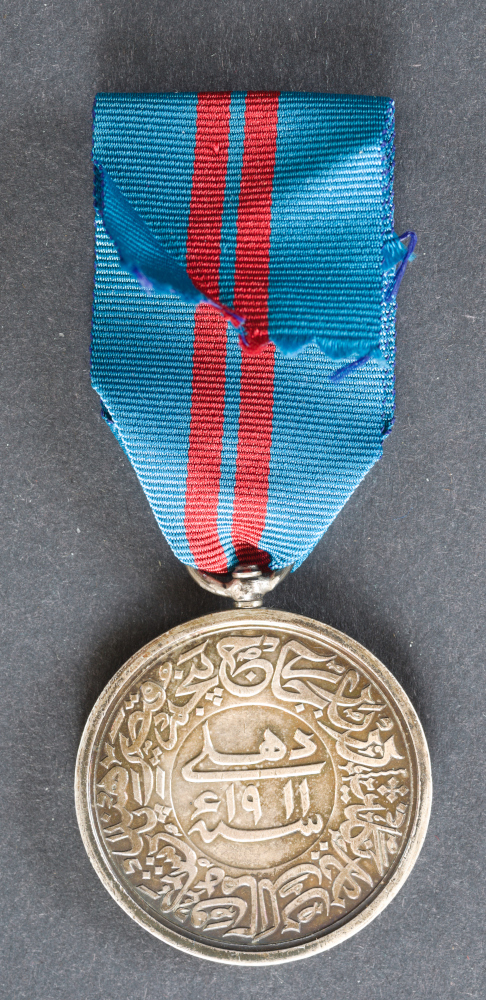
For his involvement in the Delhi Durbar where a massive celebration of the coronation of the new King George V and Queen Mary was held and the all of the governors and rulers of the Indian princely states were summoned to pay homage to the new Emperor and Empress of India.
In his memoirs, Reggie writes…
My squadron was Personal Escort to the King& Queen at the Delhi Durbar, & from a few feet distance from their Majesties I saw little Sir Pertab Singh before all those countless thousands lift the Maharajah of Baroda off the Royal Daïs with Oh! Such a mighty well placed kick behind after Baroda had insulted the King & Queen. Then it fell to my duty to put him in his carriage & escort him a prisoner to his own camp.
This video from YouTube is of the Delhi Durbar of 1911. The entry of the Maharajah of Baroda is at 1:56 mins and, while there is no doubt that he didn’t really pay homage in the prescribed manner, I see no evidence of him being booted off the daïs by “little Sir Pertab Singh”.
I guess that Reggie is one of the escort party on the daïs but I have no idea which!
 button in the top right of the map display to select which years to display.