This is the main set of timelines that tracks Reggie’s and Donald’s activities through the war.
A description of the medals awarded to Lt.Col. Reginald Hunt
The sources used in the preparation of the timelines.
Introduction
This page gives a very brief summary of World War 1 as experienced by Reggie and Donald Hunt. It is NOT intended as any kind of description of the overall war. We are concerned solely with the day-to-day experience of the brothers as they are mobilised with their respective units and go to war in Northern France and Flanders and, in Donald’s case, in what is now Namibia (then known as German South West Africa) and Northern Africa.
At the front they find that they alternate between action in the trenches and relative calm behind the trench lines. Action in the trenches is intense and sometimes chaotic. However, those periods of action are interspersed with periods of relative calm away from the front. In these periods of calm the battalions have time to rest and recover from previous exertions. They also train for upcoming actions when they next move up to the front. Training often involves such things as musketry, bombing, Lewis Gun usage, methods of attack, marching and even saluting. Very often the battalions are involved are inter and intra unit contests such as sports days, football matches and boxing matches.
The part of the Western Front where the brothers’ units were stationed from Ypres in the north down to the Somme in the south was of the order of 80 or so miles long. So the units spend a substantial amount of time moving whether by foot, train or bus between camps.
Much greater detail of the actions of the brothers and the battalions that they were serving with is to be found in the “Early lives” and yearly timeline pages.
Reggie’s war
1st King’s Dragoon Guards Regiment
Reggie was in action firstly with his regiment the 1st King’s Dragoon Guards. However, it became apparent that, due to the nature of advancing warfare technology and the battlefield conditions, cavalry regiments were no longer as relevant and able to deliver the decisive results that they had been able to in the past. The 1st KDG found themselves continually moving around in preparation to go into action but only rarely actually doing so.
When they went to the front it was generally on foot. The first action was to spend 3 days holding the line at the front at Festubert in January 1915.
The next action at the front was in late May when the 1st KDG were involved in was the attack on Hooge Chateau a few days after the 2nd Battle of the Ypres. It was in Zouave Wood on the approach to Hooge Chateau immediately prior to the attack that Reggie was wounded for the first time. He was evacuated “sick” in September maybe because of the wounds received at Hooge Chateau and would not return to the front until Christmas Day that year.
The regiment with their horses was employed in logistics moving equipment around the battlegrounds. This must have been very frustrating to the cavalry soldiers. After Reggie had been moved to other roles (see later), the 1st King’s Dragoon Guards returned to India in October 1917.
1/4th Seaforth Highlanders Regiment
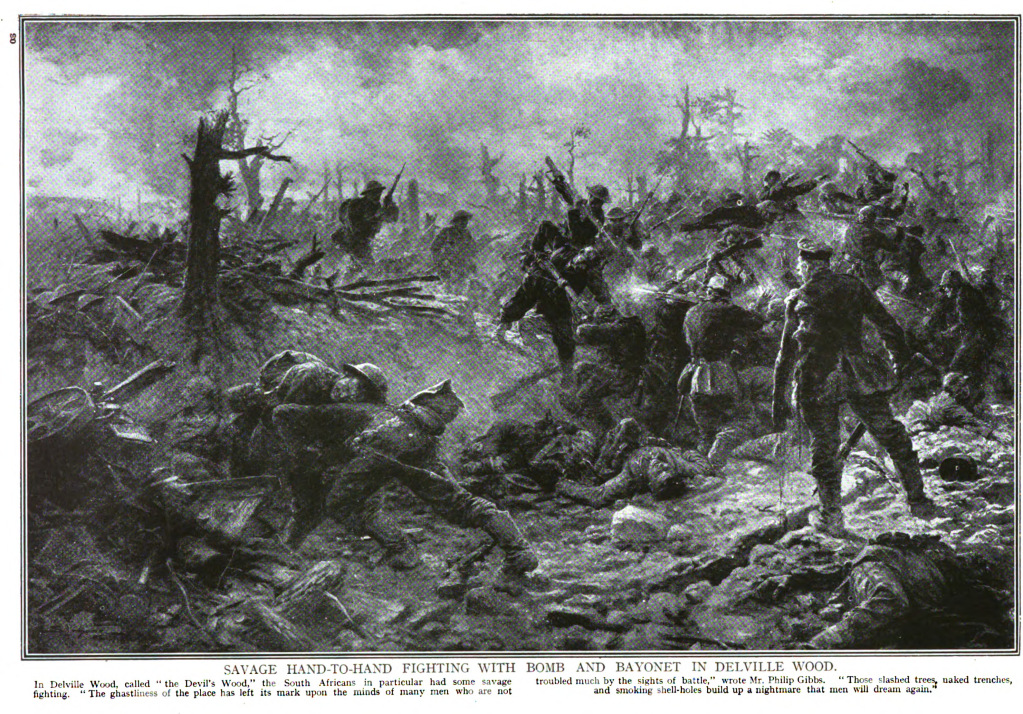
After a year and a half being only relatively rarely in action, Reggie was reassigned in June 1916 to the 1/4th Seaforth Highlanders as second in command. The Seaforths were an infantry regiment and Reggie found himself almost immediately involved in July 1916 in front line action at High Wood as part of the Battle of the Somme just a mile or two away from Delville Wood where his brother Donald had been involved with the South African Forces a few days beforehand. The attack on High Wood was not successful and very high casualties were received before the attack was called off and the battalion was relieved by the Black Watch.
It is very probable that the brothers met somewhere near Méaulte close to Albert around this time.
8th King’s Own Royal Lancaster Regiment
After just 4 months with the Seaforths, in October 1916 Reggie was given his own command. He was promoted as Temporary Lt.Col. in command of the 8th Battalion King’s Own (Royal Lancaster) Regiment. He led the battalion for one and a half years through many engagements.
The first action was at Serre-lès-Puisieux in the northern sector of the Somme battlefields. It was at Serre that the “pals battalions” had made such disastrous attacks at the start of the Battle of the Somme in July earlier in the year and the King’s Own were to have no more success in November as part of the Battle of the Ancre.
The next major push that the KORL was involved in was the Battle of Arras in May 1917. The battalion formed part of the attacks on and defence of Monchy-le-Preux and Guémappe. Reggie recalls in his memoirs that it for his leadership around this time that he was awarded the D.S.O. in the New Year’s Honours of 1918.
The final major action that Reggie led the 8th KORL through was at the 3rd Battle of Ypres (known as the Battle of Passchendaele) in September 1917. The battalion was tasked with making an approach to Zonnebeke and to try to take the German strongholds of Mühle Farm and Tokio Farm in the South West outskirts of the town. This they succeed in doing before being relieved by the 9th battalion Australian Imperial Force.
While serving with the King’s Own, Reggie was, in December 1916 and January to February 1918, required to take command at the H.Q. of the 76th Brigade as cover for the Brigadier-General while the Brigadier was absent for a period.
Finally, he took leave of the 8th KORL in March 1918. His letter to the battalion recorded in the war diaries expressed how proud he was of the men under his command and that they had never lost a trench.
He took an army training job in England before being called to the Desert Mounted Corps with the Middlesex Yeomanry where he was at the Capture of Damascus in the autumn.
Donald’s war
Transvaal Scottish Regiment
Donald joined the 2nd Battalion Transvaal Scottish in South Africa at the beginning of the war.
Donald was in action in German South West Africa with the Transvaal Scottish Regiment. His major action was at the Battle of Trekkopjes where the Transvaal Scottish repelled what was to be the last major German offensive of the campaign.
4th South African Infantry (South African Scottish) Regiment
When the 1st South African Infantry Brigade was formed Donald joined the 4th Regiment (known as the South African Scottish) and served in Egypt in the Senussi Campaign before the whole brigade was posted to the Western Front.
At the Front, the 4th South African Infantry were very soon involved in what was to be their defining engagement at Delville Wood in July 1916. The commanding officer of the 4th SAI (Lt. Col. Donald MacLeod) was wounded at Delville Wood and Donald took over the command until Lt.Col. Ewen Christian arrived in January 1917.
Donald was in command of the 4th SAI at the disastrous Attack on the Butte de Warlencourt in October 1916. The attack had never stood a chance due to bad planning by the higher command who had failed to provide any significant advancing barrage.
Donald took leave in February 1917 to get married to Grizel Guillum Scott in March and was probably not present at the beginning of the 1st Battle of the Scarpe in April but returned soon after. Lt.Col. MacLeod also returned soon after the Scarpe action having recovered from the wounds received at Delville Wood.
Donald swapped command with MacLeod at periods through 1917 including at the 3rd Battle of Ypres (Passchendaele) in September and October where he led the 4th SAI through what the battalion’s war diaries describe as the very worst few nights (the 13th/14th October) in the entire war up to that point in the mud and gas near Poelcapelle on the approach to the village of Passchendaele.
Dunsterforce
At the beginning 1918 Donald was cherry-picked to join General Dunsterville’s British Military Mission to the Caucasus (known as Dunsterforce) in the Middle East where the mission was to protect British interests in the area by co-operating with Russian forces in preventing German and Ottoman forces from reaching Central Asia, Afghanistan and India. The British interests almost certainly involved the vast oil sources in the area.
Overview map
This map shows the principal locations where Reggie and Donald Hunt served and fought during World War 1.


Structure of the British Army in World War 1
It may be useful to have a short description of the hierarchical structure of infantry units of the British Army.
| Unit name | Consisting of | Led by |
|---|---|---|
| Army | The British Army consisted of 4 armies each of the order of over 100,000 men. | General |
| Corps | Of the order of 50,000 men | Lieutenant General |
| Division | H.Q., 3 brigades, artillery units, cavalry, signals units, field ambulance. In total 16,000 to 18,000 men | Major General |
| Brigade | H.Q. and 4 battalions. In total of the order of 4000 men | Brigadier General |
| Battalion | 4 companies. In total 500 to 1,000 men | Lieutenant Colonel |
| Company | 4 platoons | Captain |
| Platoon | 50 men | Lieutenant or 2nd lieutenant |
How this research came about
I had been aware for some time that my great uncles Reggie and Donald Hunt had served in WW1. I knew I had a letter that was written from the trenches by Reggie to my grandma which described something about life in the front line. Apart from that I had no real idea of what these two brothers had done during the war.
At a family event in the middle of the 2024, my sister asked me to do some research into a name the she and her husband had found on a church war memorial. The name was the same as her married name but neither she nor her husband knew anything about any person of that name or whether he was even a relation. I found the name of the unit that the soldier was serving in and also that he was my brother in-law’s great-grandfather but then I wanted to find more about the circumstances of his death.
The hunt led me to discover the WO 95 war diaries which are available to download from the UK National Archives. The war diaries were written by British Army units involved in action. Each diary was written up every day and detailed the activities of the unit over the course of the day. Where they were, what they did, (sometimes) who did it, what was the result. The diaries are downloadable free from the National Archives to those with an account on their website.
With this new resource, I was able to track the circumstances of the death of the soldier and the events leading up to it.
This page is the result of using the WO 95 diaries and many other sources to trace the activities of the units of and (very often) the individual actions of my great-uncles Reggie and Donald themselves. We follow them through the lead up to their involvements in the war. We follow them as they get involved in battles whose names are imprinted on the consciousness of all who know anything at all about the Great War. The Somme. Ypres, Passchendaele. Arras. Armentières. Vimy. Every one of those places and many, many others feature in this story.
Even after they left the Western Front towards the end of the war there were still stories to tell about these two brothers. They were each selected for separate missions in the middle east that could almost be described as “Boy’s Own” adventures in themselves. Donald joined Dunsterforce and Reggie joined the Desert Mounted Corps. However, those stories will have to wait for future detailed research.
 button in the top right of the map display to select which years to display.